Why we stay on platforms that care less about us
In any relationship, the one who cares less holds the power.
Sociologist Willard Waller called it the “principle of least interest” nearly a century ago. In college, I heard it framed as the “Rule of Least Concern”: the party least concerned with the relationship controls it. That party can be a person or an organization. That’s why they say you can’t negotiate unless you’re willing to walk away.
Of course, in healthy relationships, whether friendship or romance, employment or business, there is compromise. Long-term relationships work because they allow for back-and-forth. One party yields on an issue it considers less important, and the other does the same another time.

Who Cares More?
Consider this: Who cares more about your relationship with your favorite social media platform—you or the company that owns it? Multiply that by every social app on your phone.
Now, take a moment and imagine deleting them—or maybe just one. Which one would you choose? How would you feel? Odds are, the thought of pulling the plug was unsettling, even alarming. Not because you care about the platforms or the companies, but because they increasingly control the ties that bind you to the people and things you do care about. They’ve also become the stage where you seek recognition and validation.
The companies behind them built an empire on the Rule of Least Concern, not the compromise.
Hooked
Many of us know our relationships with social media companies aren’t healthy. But we’re hooked: the platforms made us care more while they cared less.
How many times have social platforms offended you, troubled your conscience, even appalled you? How many times have you wanted to step away? Maybe you did. And maybe, like most of us, you came back, because no one likes feeling left out—or alone. They knew you would.
I unplugged for eight years. I deleted every social media account except LinkedIn. It was both liberating and isolating. I didn’t miss the politics, the vitriol, or the divisiveness. But I missed friends’ milestones, community events, the jokes and the banter. I could hear only pieces of the conversations around me, as though I lived in a foreign land where the news arrived late. Then I came back.
The Verdicts Are In
Today what many of us sensed isn’t just a hunch; it’s the news, and the proof is piling up. A Los Angeles jury found Meta and Google’s YouTube negligent in designing platforms that harmed a young user, and Meta’s settlement of up to $18 billion with nearly every state suggests the company knows the verdict wasn’t a fluke.¹
More recently, a New Mexico judge ordered Meta to pay $25 billion for misleading users about their privacy. Citing an “extraordinary number of willful violations,” Judge Francis Mathew wrote that the harm “goes to the heart of Facebook’s basic business proposition.”²
Yet despite what we’ve witnessed and the mounting verdicts, most of us are still logged in.
Pushed Outdoors
Increasingly, critics compare social media companies to tobacco companies. Not just because their products are addictive, but because addiction is the business model.
The legal arc looks familiar, too. In 1998, forty-six states settled with the tobacco industry for $206 billion and limits on marketing to young people.³ Meta’s settlement in August 2026 followed the same script: billions in payments and default time limits for teenagers.
Addiction is how the Rule of Least Concern works. Every notification, every like, every endless scroll makes us care a little more. Meanwhile, the companies care only as much as the courts require.
But the comparison breaks down in important ways. When smokers quit, they save money and their health improves. Smoking could also be contained, confined to designated sections and eventually pushed outdoors. Social media can’t be confined to a designated section; it’s everywhere. And when we quit social media, we don’t just lose a habit—we’re the ones pushed outdoors. Cigarettes never held anyone’s friends or window on the world hostage. That’s what makes this addiction so hard to break. It’s also why, with a book to launch, I returned.
Return Without Surrender
So how do you return without surrendering? With awareness. Knowing the Rule of Least Concern puts any relationship in a different light. It lets you weigh the give-and-take more honestly and set limits where they belong. It helps you manage the relationship, even when you can’t walk away.
Meta recently changed the deal. Through its new Meta One subscription, the company now wants me to pay to share more than two links a month on my Facebook business page. That’s what the party least concerned does: it sets the terms. My choice: I don’t pay. I point readers to my own website and newsletter, where the relationship is mine. I post with a purpose, then step away.
Meta is not alone. X’s owner admits posts with links get less reach and tells users to bury links in the replies.⁴ Reddit priced popular outside apps out of existence almost overnight.⁵ Even on LinkedIn, the one account I kept, I’ve learned to put links in the first comment.⁶ Every link is an exit, and the party least concerned controls the doors.
Social platforms don’t care about you; they care about your attention. And that’s the part of the relationship you control.
You can stay concerned. But you don’t have to surrender control.
Be aware. Be deliberate.
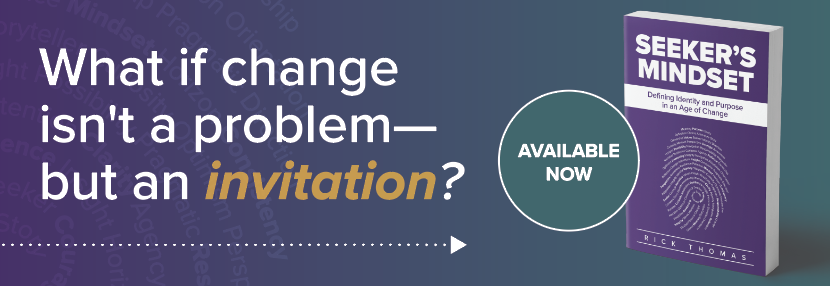
The ideas in Pragdealism are adapted from my book, Seeker's Mindset.
To learn more, visit: www.seekersmindset.com.
Notes:
¹ “Meta Settles with States in Landmark Social Media Addiction Trial,” ABC News, August 26, 2026, https://goodmorningamerica.com/news/story/meta-settles-states-landmark-social-media-addiction-trial-135967095.
² “Meta Ordered to Pay $25 Billion for Deceiving Users on Privacy,” The New York Times, October, 21, 2026, https://www.nytimes.com/2026/10/21/technology/meta-penalty-new-mexico.html?searchResultPosition=1.
³ U.S. Government Accountability Office, Tobacco Settlement: States’ Use of Master Settlement Agreement Payments, GAO-01-851 (Washington, DC, June 2001), https://www.gao.gov/products/gao-01-851.
⁴ “Elon Musk Admits X is Throttling Links—Effectively Limiting People from Reading News,” Mediaite, November 25, 2024, https://www.mediaite.com/media/news/elon-musk-admits-x-is-throttling-links-effectively-limiting-people-from-reading-news/.
⁵ “Popular third-party Reddit app Apollo is shutting down as a result of Reddit’s new API pricing,” TechCrunch, June 8, 2023, https://techcrunch.com/2023/06/08/popular-third-party-reddit-app-apollo-is-shutting-down-as-a-result-of-reddits-new-api-pricing/.
⁶ “Experiment: Do LinkedIn Posts with Links Get Less Engagement and Reach?” Hootsuite, March 29, 2021, https://blog.hootsuite.com/linkedin-engagement-experiment/.