Warped Reflections
Leaving Fingerprints on the Future
What do you see when you look in the mirror? Or more accurately: how do you feel when you look in the mirror?
The answer, of course, depends on the mirror and the environment surrounding you. In good lighting, a standard mirror reflects a familiar image, one you may even like, along with a clear sense of the space you inhabit. But shift the lighting — make it dim or harsh — and both your appearance and emotional response change. Twist, bend, or distort the mirror's surface, and your perception of yourself and the context of your circumstances will be altered, sometimes dramatically, perhaps even to the point of becoming unrecognizable.
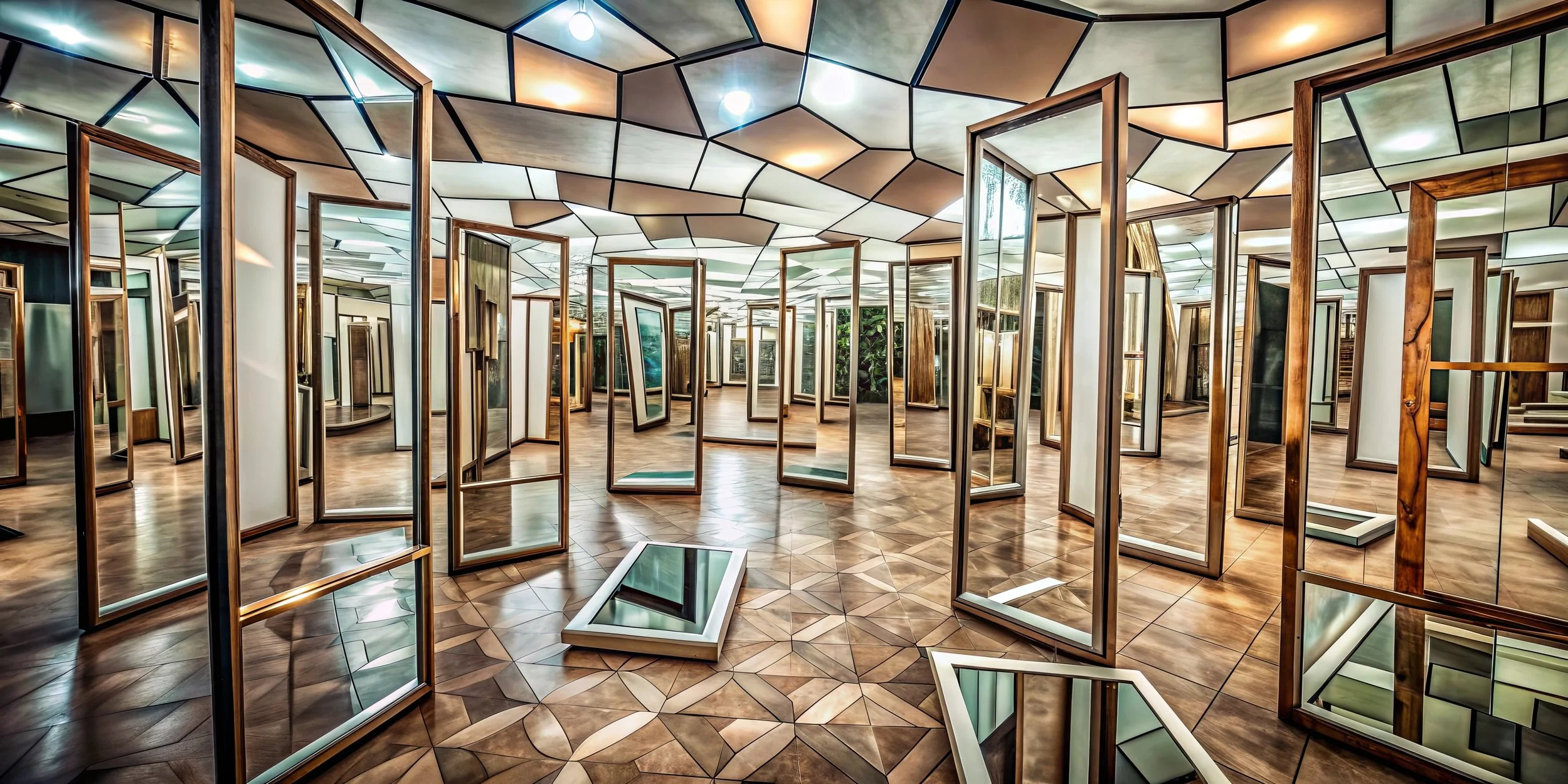
Our ecosystem — the people we interact with and the places where we live, work, and play — functions like a mirror, reflecting how we understand ourselves and shaping our sense of place in the world. Jim Rohn, the entrepreneur and motivational speaker, is often credited with reflecting on this idea: "You are the average of the five people you spend the most time with."¹ It's an insightful observation, but it falls short of the reality, because it does not take into account our environment, the world we inhabit and navigate every day.
When that environment is stable, the image we see feels recognizable and coherent. But change can distort what we see. When change becomes tumultuous, it twists and bends our ecosystem, and the reflections begin to look warped, even unrecognizable, like those cast by the mirrors of a carnival fun house.
When the Mirror Warps
The mirror metaphor is simple, but profound. The shift in perspective we experience during extended periods of tumultuous change is difficult not only because it reshapes our understanding of the environment we operate in, but also because it alters how we see ourselves within it. And we are not the only ones standing before a warped image. The same upheaval reaches the five people Rohn named and beyond: everyone facing a distorted reality of their own, their sense of self shifting in the same moment ours does.
Change is often difficult, but this shift in our reality is different because everyone and everything are in flux all at once. This kind of disruption demands an increased level of mental effort and taxes emotional energy, while eroding our sense of security and well-being. It can distort and devalue past accomplishments, including the time we've invested. We can be left feeling that both control and authority over our lives have diminished, or, worse, been taken away. As a result, we may feel exposed, vulnerable, less capable, and even alone.
The experience can be both disorienting and exhausting. These shifts upend familiar routines and long-standing relationships, forcing us to rebuild knowledge and adapt to new realities, a process that often feels uncertain and risky. And if we don't invest in new connections and acquire new skills, they can also threaten our relevance and self-worth.
We've Been Here Before
Shoshana Zuboff, in her book The Age of Surveillance Capitalism: The Fight for a Human Future at the New Frontier of Power, quotes Thomas Edison from his letter to Henry Ford: "We've stumbled along for a while, trying to run a new civilization in old ways, but we've got to start to make this world over."² Edison was likely referring to the impact of the Industrial Revolution and the human tendency to resist change. We've been here before, in that intertidal zone where the tide sweeps away what was before what will be becomes visible. Upheaval and disorientation are natural side effects of innovation and its byproduct, disruption.
It is hard to fathom now, but there was a time when people feared electricity as unnatural, as a usurpation of God's power over life and light, and as an invisible killer, or believed that "if people were meant to fly, they would have wings."³ I suspect few would elect to surrender these modern conveniences today.
I am not suggesting that innovation and the resulting impacts we are experiencing today have not been profound and that the path ahead is not shrouded in the fog of uncertainty — they have been, and it is. We are experiencing transformation at a speed and scale unknown in human history. But then again, the people of Edison and Ford's day likely felt that life was moving quickly and the future was shrouded in fog too. After all, this was the time of the Second Industrial Revolution: the day of the electric light and the telephone, the phonograph and the moving picture, the automobile and the assembly line, wireless radio and, in many ways the most unsettling of all, powered flight.
Our Turn
Throughout human history, there have always been periods of intense, disruptive, disorienting, and, of course, unimaginable innovation. The life we live — and, yes, despite the challenges ahead, enjoy — is the product of past generations navigating and persevering through the unexpected, the uncertain, and the unknown.
Time will pass. Change will happen. The only question that remains is what you choose to do next. As with generations past, your thoughts, words, and actions will leave fingerprints on the future.
The ideas in Pragdealism are adapted from my book, Seeker's Mindset.
To learn more, visit: www.seekersmindset.com.
Notes:
¹ Garson O'Toole, "Quote Origin: You Are the Average of the Five People You Spend the Most Time With," Quote Investigator, Aug. 8, 2022, quoteinvestigator.com/2022/08/08/five-people/.
² Shoshana Zuboff, The Age of Surveillance Capitalism: The Fight for a Human Future at the New Frontier of Power (New York: PublicAffairs, 2019), 16.
³ Ernest Freeberg, The Age of Edison: Electric Light and the Invention of Modern America (New York: Penguin Books, 2014), 105, 234.