Technology keeps accelerating. We don’t.
If you're feeling frazzled, stressed, and generally overwhelmed about how to keep up, there's a reason: technology evolves at a dizzying pace. Our biology, not so much.
This mismatch between what we can create and what we can assimilate came into focus in the first part of my career in the audiovisual business. When I joined the industry in 1996, the multimedia projector was a new and fascinating technology. You could actually see a computer image displayed on a projection screen. Mind you, all the lights had to be out, and the resolution was so low that today, if you saw one, you would think something was wrong with it. It would be like comparing a TV from the 1970s to today's flat-panel displays.

The technology, specifically image quality, advanced quickly—until it didn't. You likely saw the improvements in marketing slogans and on the sides of boxes: HD, Hi-Res, 2K, 4K…8K. The upgrades kept coming because they kept selling. But at some point we stopped caring. The advance didn't matter anymore. Why? Because at some point, we could no longer see the difference. The technology kept improving. Our ability to see, as many of us know all too well, tends to follow a different trend over the years. We don't need higher resolution. We need glasses.
This is the irony of our time. We can imagine and create amazing technologies. Capabilities that were once the stuff of science fiction are advancing at an ever-increasing rate. Yet one thing hasn't changed: our biology. Our humanness still requires that we experience and interact with these advancements as we have for thousands of years—through our senses, chiefly sight, sound, and touch. That's why we have keyboards, mice, microphones, speakers, and touch screens. Technological advancements don't matter if we can't experience their benefits. It's also why the most enticing thing about new display technologies today tends to be the price. It's often the only differentiator that we can still perceive and value.
So many possibilities. Such human obstacles.
Upgrading ourselves
The technology-biology gap is why the people building our future are working so hard to develop AI, brain–computer interfaces, and other ways to augment our biology. Isn't that what the Ray-Ban Meta smart glasses are designed to do? They put a camera, open-ear speakers, and an AI assistant into an ordinary-looking pair of frames. In other words, they augment our biology in an effort to make us more capable and comfortable navigating a world that moves faster than we do.
None of this is new. Throughout human history, we have innovated and leveraged tools to make our lives better, easier, and more enjoyable. From mastering fire and inventing the combustion engine to advancing science and medicine and beyond, we have steadily expanded our ability to shape our experience of the world.
But as the display technology example above demonstrates, technical advancement loses its value if our biology can't keep up. With displays, our limits simply made the upgrades pointless. With nearly everything else, they make the pace exhausting. That is why the challenge is shifting. It is now less about changing our experience of the world and more about changing our experience of ourselves.
The cost of keeping up
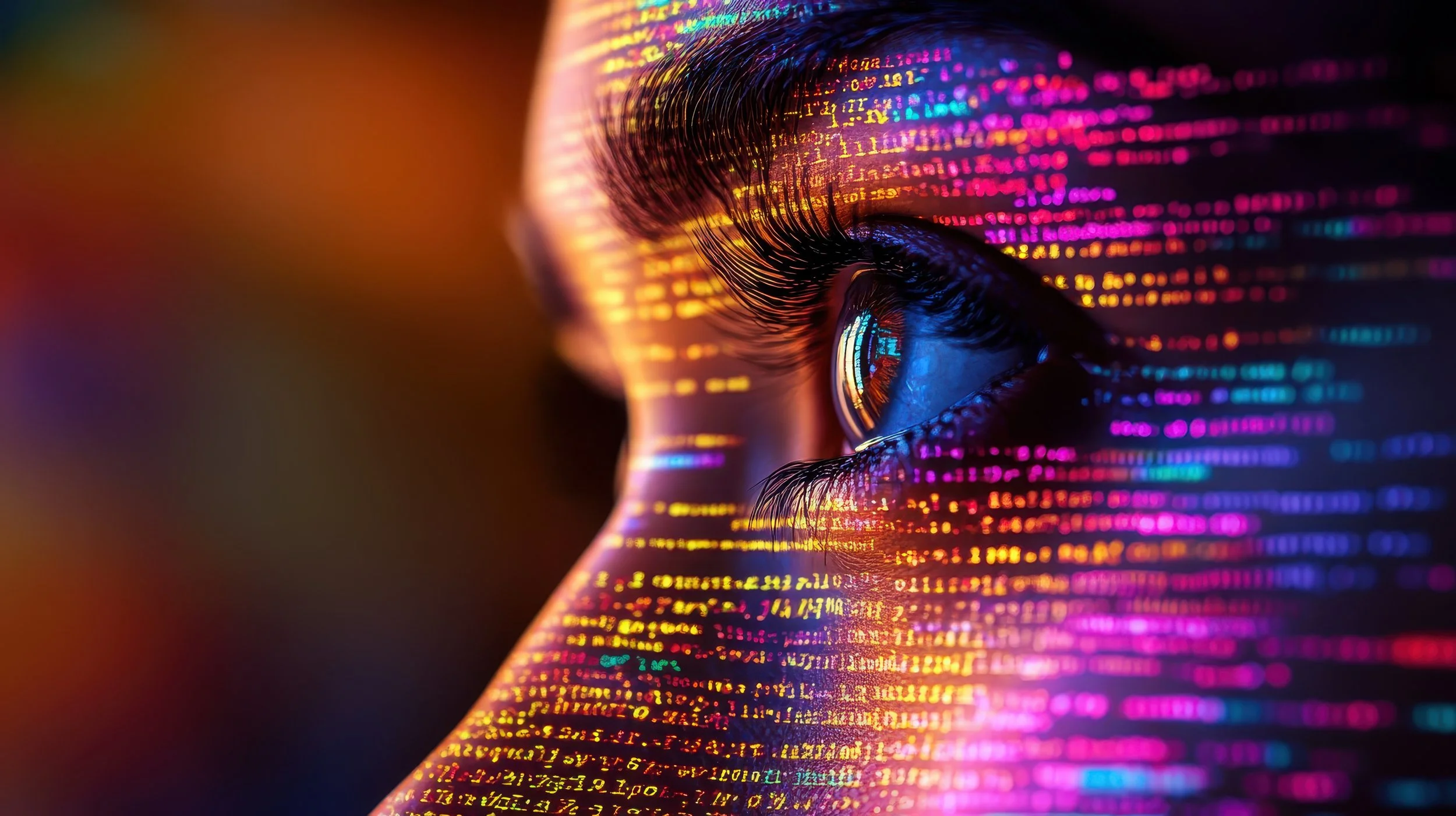
We are biologically limited. A 2024 Caltech study estimated that while our senses take in roughly a billion bits of information per second, our conscious thinking processes only about 10.¹ A typical home internet connection moves data millions of times faster than we can think.² And that hardware hasn't been upgraded in a very long time. Our brains reached their present form somewhere between 35,000 and 100,000 years ago.³ Since then, we've gone from cave paintings to smartphones, all running on the same biology. More challenging still: the leap from analog to digital, from the first personal computers to AI, has happened within the last 50 years.
But our limits are not only a matter of processing speed. Beneath all of these technical advancements and efforts to alter our experience of the world lies something uniquely human. How we experience the world depends not on how much we can do or how fast we can do it, but on how we feel about what we encounter and what we do. Yes, being efficient and productive can be satisfying, and learning something new can be rewarding. But no one I know enjoys a perpetual state of "just trying to keep up" as the status quo. It's exhausting. And at times, demoralizing. Yet isn't that where we are today?
And still, that pace can be addictive. I've been there. I've felt that. Both the speed and the perpetual state of "new" can draw you in—until they wear you out.
Maybe that is why our always-on world has been met with a corresponding rise in depression, anxiety, and other mental health struggles.⁴ We have built tools that let us do more, faster, and, in theory, with less effort than ever before. Yet many of us feel more overwhelmed, more distracted, and less content than the generations that came before us. Our devices keep up with our ambitions, but our nervous systems still move at the speed of biology.
More and faster may not equate to better. Sometimes, it may simply mean more to process and less time to enjoy any of it.
We set the pace
Some are already pushing back. A 2026 survey found that 63% of Gen Z—the first generation raised on smartphones—are making an intentional effort to spend less time on screens.⁵ Sales of "dumbphones" rose 25% last year.⁶ Film cameras, vinyl records, and handwritten journals are finding new life among people too young to remember them the first time. They aren't rejecting technology. They're choosing how much of it to let in.
We are living in an increasingly technical world. But one fact remains: we are still having a deeply human experience, and our biology isn't going to catch up naturally anytime soon. Technology will keep accelerating. And it's worth remembering why. Increasingly, the relentless pace has less to do with what we need than with business, profit, control, and, for some, fame. It is a version of the future that is being marketed and sold. The only question is whether we let someone else’s vision and goals set the pace of our lives, or whether we set it ourselves.
The good news is we get to choose. Not necessarily how the world works, but how we engage with it. We can decide when to pick up the phone and when to put it down. We can choose depth over speed, presence over productivity, and meaning over more. And as the purveyors of technology work to move it from our hands to our faces, and perhaps someday into our brains, the choice will be less about when to put the device down and more about what we're willing to accept—and how much of our human experience we're willing to let it change.
We are the market. We vote with our attention, our time, and our money. We can embrace what technology makes possible without surrendering what makes us human.
Our choices matter. Because in the end, the measure of our lives won't be how much we did or how fast we did it. It will be how we felt about what we experienced—our Fun-to-Misery Ratio—and who we were while experiencing it.
The ideas in Pragdealism are adapted from my book, Seeker's Mindset.
To learn more, visit: www.seekersmindset.com.
Notes:
¹ Zheng, Jieyu, and Markus Meister. "The Unbearable Slowness of Being: Why Do We Live at 10 Bits/s?" arXiv, November 2024, https://arxiv.org/abs/2408.10234.
² Zimmer, Carl. "The Speed of Human Thought Lags Far Behind Your Internet Connection, Study Finds." The New York Times, December 27, 2024. https://hawaiitribune-herald.com/?p=336027.
³ Neubauer, Simon, Jean-Jacques Hublin, and Philipp Gunz. "The Evolution of Modern Human Brain Shape." Science Advances 4, no. 1 (January 2018), https://www.science.org/doi/10.1126/sciadv.aao5961.
⁴ Brody, Debra J., and Jeffery P. Hughes. “Depression Prevalence in Adolescents and Adults: United States, August 2021–August 2023.” NCHS Data Brief No. 527, Centers for Disease Control and Prevention, April 2025. https://www.cdc.gov/nchs/products/databriefs/db527.htm.
⁵ Talker Research for ThriftBooks, 2026 generational survey on digital disconnection, as reported by GCN, July 31, 2026. https://gcn.com/?p=20286.
⁶ "Analog Experiences Are Back in Vogue in 2026. Here's Why." Yahoo Lifestyle, 2026. https://www.yahoo.com/lifestyle/articles/analog-experiences-back-vogue-2026-100000052.html.