Even Uncertainty Has Changed
A Break. A Choice. A Future.
I am surprised Webster's Dictionary or Google has not identified uncertain, and its derivative uncertainty, as the most prevalent words of the year. The term is everywhere and on everyone's mind. But why? Life has always been unpredictable and never offered any guarantees. Maybe that is why the people and organizations that track such things have not taken notice.
But the type of uncertainty that stands before us is different.
The Break
In the past, uncertainty typically presented itself as small cracks, sometimes as a crevasse, in the path ahead, something we had to compensate for, work our way around, or navigate through. But on the whole, the rest of our world remained stable, predictable, and familiar. That stability was the wall we kept a hand on as we felt our way past the unexpected and difficult turns in the labyrinth we call life.
What stands before us now appears instead as a tear in the future — an unexpected hole so large that there is rarely anything familiar to lean on, and when we find something, it often feels unstable or falls away.
But an uncertain future, no matter its scale, is just a condition. On its face it is neither good nor bad; it is just indifferent. It is you and me who assign uncertainty its meaning and emotional weight. Do we see it as precarious or ominous, vague or unpredictable, fluid or promising?
The Choice
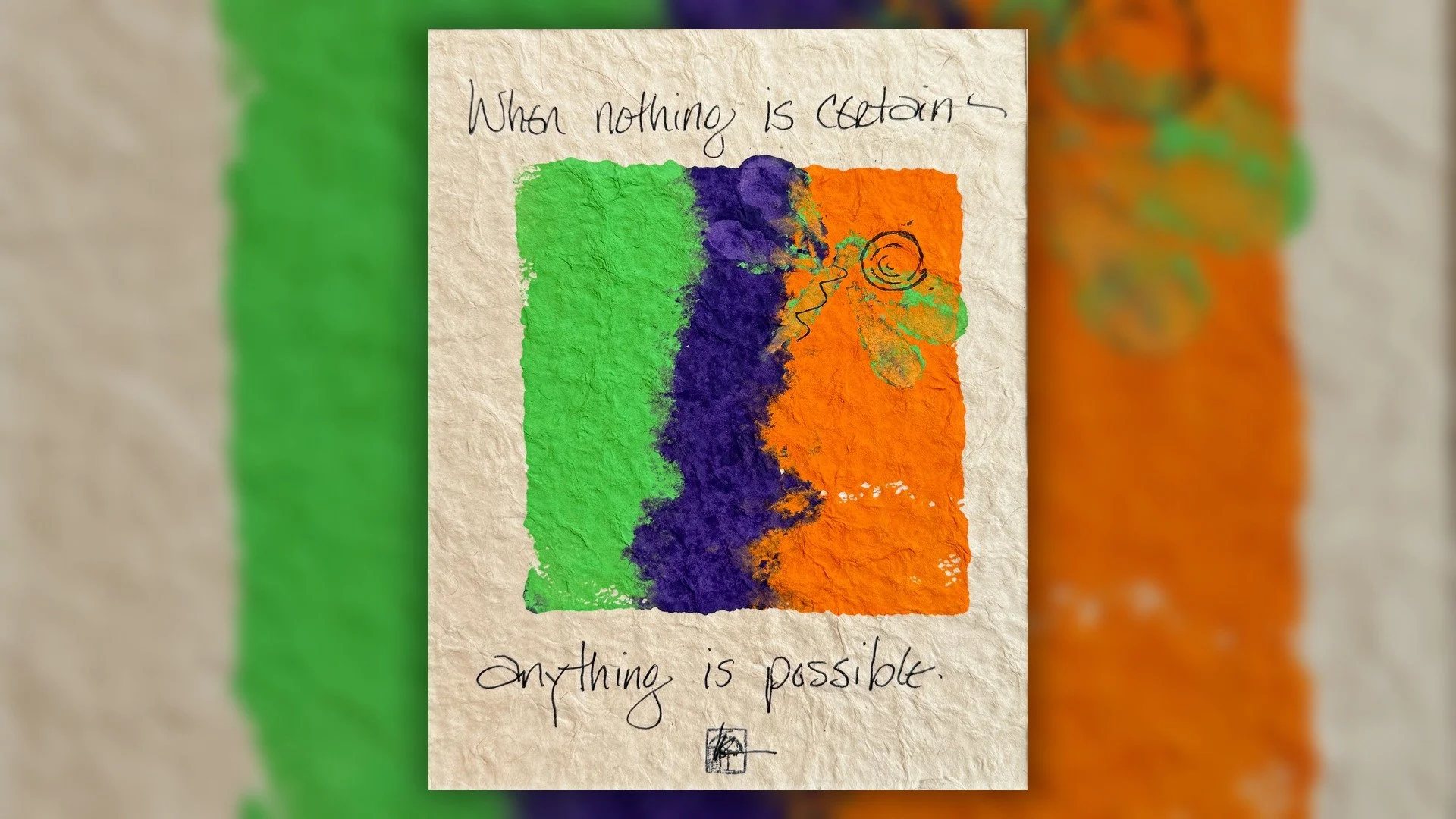
I found my own answer long ago. I spent most of my career immersed in the technology world, specifically the commercial audiovisual industry, the majority of it as a business owner. One day, years back, I was in a small shop in Fairbanks, Alaska, and saw a framed piece of art that read: "When nothing is certain, anything is possible." It spoke to the world of perpetual change and uncertainty I was navigating. I bought it and hung it in my office. I looked at it every day. I still do.
The flip side of the quote is: When everything is certain, nothing new is possible.
Most people don't think of uncertainty as a harbinger of possibility, but that, in fact, is what it offers. That is why our attitude and approach in response to uncertainty matter.
It is not my intent to make light of the risk that change and uncertainty present. Over the years I have had many unexpected moments I would have preferred to turn away from — plans undone, a future that took a different path. I know I am not alone. Having the known fall away and open into a cavern of the unfamiliar and unexpected can be frightening, even terrifying. My argument is that the events that deliver uncertainty are often beyond our control, and that once they arrive, it is our approach to the new that will have the greatest impact on the future we live.
That is because our response to events, especially those that leave us feeling uncertain, is calibrated by three things: our past experience, our confidence that we can persevere, and our expectations of what lies ahead. And each of those, in turn, is colored by attitude: how we feel about the past, how we feel about ourselves, and how we feel about the world around us. Experience is lived. Expectation is derived. Attitude is ours to choose.
This is why two people can look at the same conditions and see different possibilities, one dreading potential peril, the other inspired by potential opportunity. Psychologists call it appraisal: each person reads a situation through their own history, self-belief, and outlook.
I get it. Choosing and maintaining our attitude in the face of uncertainty is hard, and we're rusty. Most of us are out of practice at meeting large-scale, world-altering uncertainty — and adapting when the familiar falls away — because from a historical perspective the past several decades have been relatively calm, stable, and predictable. Yes, many of the concerns now burning on the horizon have been approaching for just as long, but life has been good, and we have been busy, and they have been convenient to ignore.
The Future
Nonetheless, here we are. Our world is changing in ways few could have imagined and many still struggle to comprehend. It's economic. It's political. It's social, cultural, and spiritual. It's our climate. It's technological. It's artificial intelligence and robotics. It's literally how we interface with and relate to our world. It's everywhere. It's all at once.
To direct and control something in perpetual motion is exhausting. To direct and control multiplying things in perpetual motion is impossible. So what can we do? Focus on the one thing within our control: our attitude. More specifically, our appraisal of the shifting conditions we are now navigating.
When something breaks, it often breaks in more than one place. To many, it can feel as though the future itself has shattered. And they may be right. But we should not forget that the gaps between the pieces are where opportunity resides — and what fills them is ours to shape: our attitude and our choices are the material from which we build the future anew.
We are living through an Intertidal Moment — the turbulent space between what was and what is becoming. Familiar structures dissolve. Old scripts no longer bind. The path ahead is shrouded in fog. But an intertidal zone is not only where things come apart; it is where new life takes hold. And it is about us: each of us. Our vision. Our intent. Our identity. A moment when our thoughts, words, and actions carry more weight than they would in calmer times.
Because when everything is uncertain, anything is possible.
This essay is adapted from Rick Thomas's forthcoming book, Seeker's Mindset: Defining Identity and Purpose in an Age of Change.